
Disabled Toilet Keys in Europe: RADAR Key & Euro Key

Travelling with a disability comes with enough planning as it is. The last thing you want, is to arrive at a public toilet, find it locked, and realise you don’t have the right key or did not even know a key existed.
Across Europe, many accessible toilets are kept locked to prevent misuse. Getting in requires a specific key, and which key you need depends entirely on where you are. The two main systems are the RADAR key, which covers Great Britain, and the Euro key, used across much of continental Europe.
This guide explains how both systems work, where they apply, and what to do in the places they don’t.
The RADAR Key: Your Best Friend in the UK
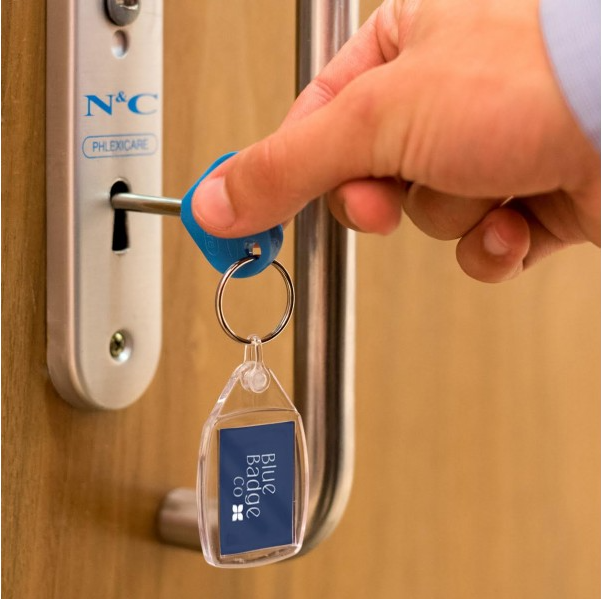
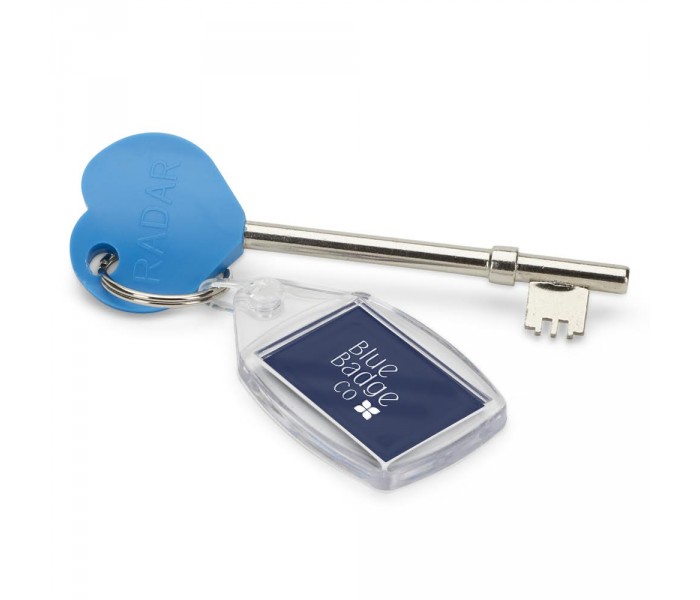
The first system is the Radar Key. If you are visiting Great Britain this is the one to have. It opens more than 14,000 accessible toilets across England, Scotland and Wales, making it by far the most comprehensive disabled toilet access system in Europe.
The scheme is run by Disability Rights UK, and ordering is straightforward. There is no proof of disability is required. You simply purchase one online for £5 at Disability right UK or the Blue Badge Company Delivery is fast, and the key arrives ready to use.
The Euro Key: Accessible Toilets Across Europe
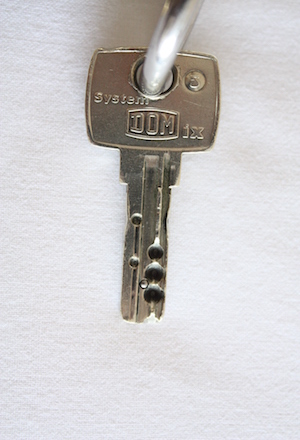
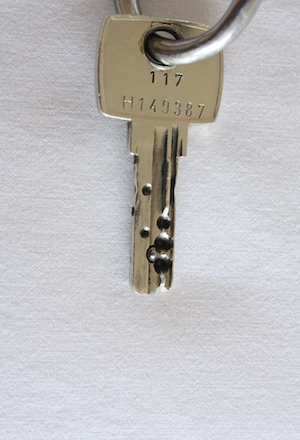
The Euro key, known in German as the Euroschlüssel, was introduced in 1986 by CBF Darmstadt. It operates around 12,000 locked accessible toilets across 16 European countries, including Germany, Austria, Switzerland, the Netherlands, France, Italy, Spain, Portugal, Sweden, Norway, Denmark, Finland, Czech Republic, Romania and Bulgaria.
In practice, coverage varies enormously. Germany, Austria, Switzerland and the Netherlands have the most reliable networks. In southern Europe, including Spain and Italy, the system exists but is far less consistent. Many accessible toilets in these countries are either freely accessible or managed by staff rather than using a Euro key lock.
How to order the Euro Key
The Euro key is available directly from CBF Darmstadt, the German organization that manages the scheme. A key costs €28.90, or €37.50 if you add Der Locus, their printed location guide. It lists more than 12,000 locations. This guide covers only Germany, Austria and Switzerland. For broader coverage across Europe, the toilet finder app Accessaloo is a more practical option.
The key is also available through Pro Infirmis, the Swiss disability organisation, for 50 Swiss francs. Pro Infirmis is Switzerland’s largest non-profit organisation supporting the independence and inclusion of people with disabilities
CBF ships to most European countries but no longer delivers to the UK due to Brexit. However, UK travellers can still order the Euro key through Pro Infirmis in Switzerland.
Good to know: The Euro key and RADAR key are completely different systems and are not interchangeable.
Who is eligible for a Euro key?
Unlike the RADAR key, you need to provide proof of disability to purchase a Euro key. The Euro key is only available to people who genuinely need access to accessible toilets. To order, you need to provide one of the following:
A copy of a registered disability card, such as the European Parking Card or a national equivalent, is accepted if it confirms a significant mobility-related disability.
A letter from your doctor is also accepted, particularly for conditions that may not be covered by a standard disability card. This includes people with a stoma, multiple sclerosis, Crohn’s disease or ulcerative colitis.
In Germany, a Schwerbehindertenausweis with the markings aG, B, H, BL, or G combined with a disability grade of 70 or higher qualifies automatically.
For travellers from countries without a formal disability card system, a doctor’s letter is always considered sufficient proof.
What the Keys Don’t Cover
The RADAR key and Euro key solve one specific problem: getting through a locked door. But the Euro key network is thin in countries like Spain, Portugal and Italy.
Coverage varies even in countries where the system officially exists. And sometimes you simply need to find the nearest accessible toilet right now, without knowing the area or whether a key will even help.
This is where a physical key reaches its limit, and where Accessaloo picks up.
Accessaloo: Finding Accessible Toilets Wherever You Are
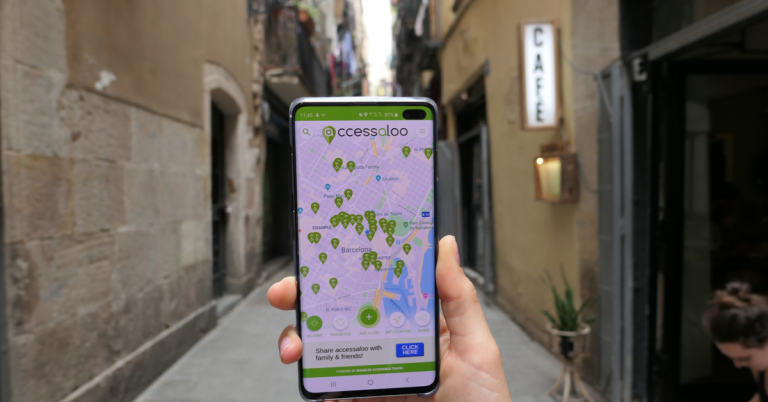
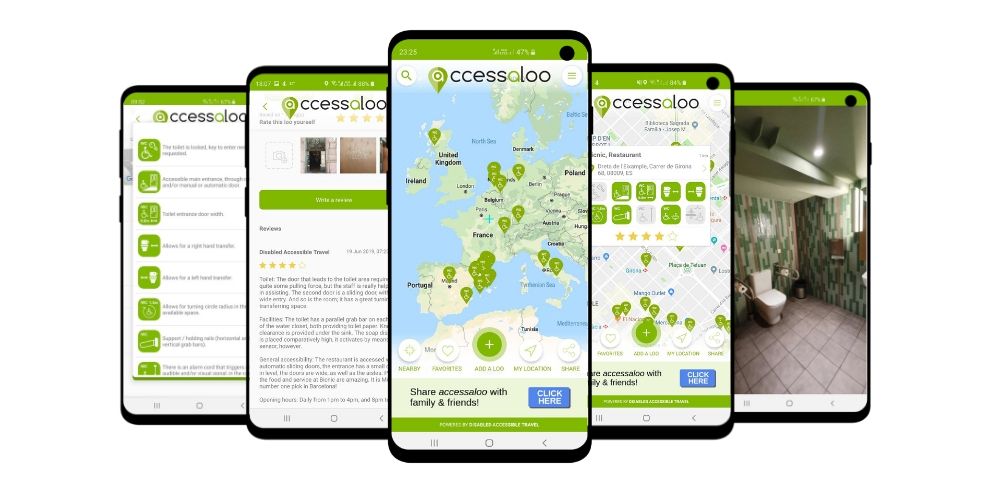
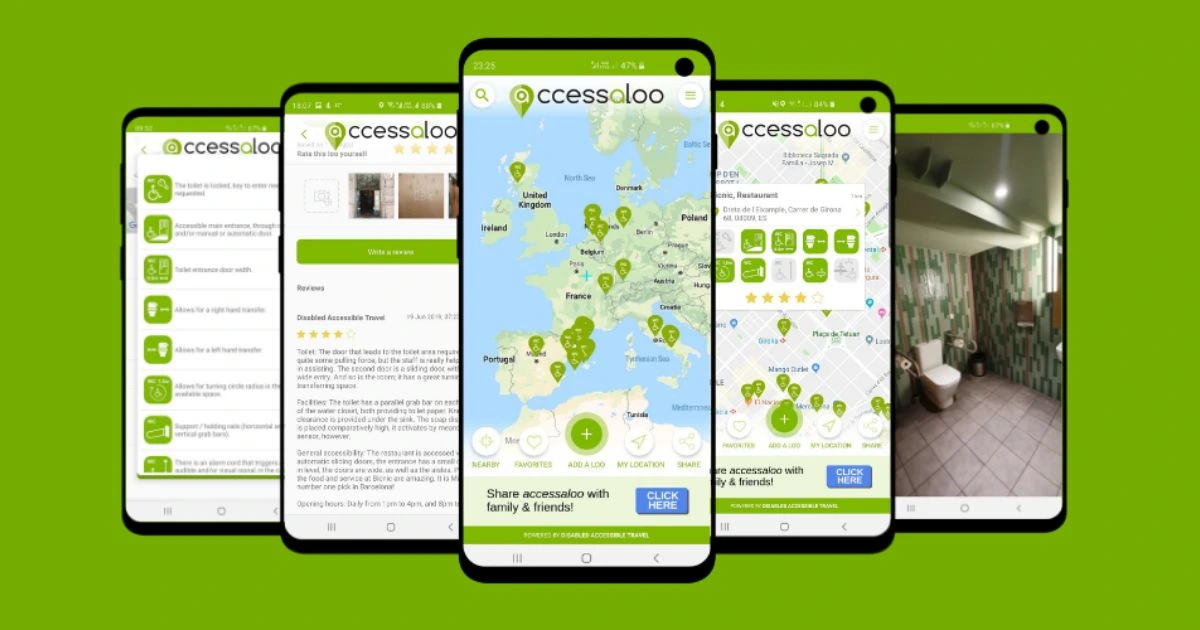
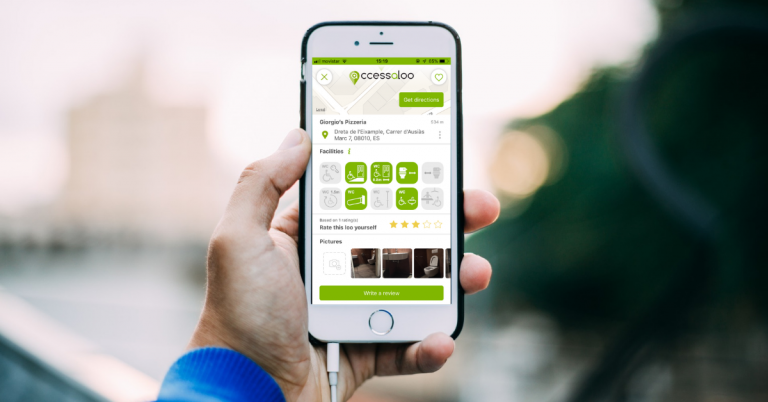
Accessaloo is a free app that maps accessible toilets across Europe and beyond. It covers freely accessible facilities, key-operated toilets and Changing Places locations, all in one place.
What sets Accessaloo apart is that it is built entirely on real user reviews. Every toilet in the app has been visited and rated by someone who actually uses accessible facilities. You can see photos, read notes on turning space, grab rails and step-free access, and check whether a place lives up to its accessible label before you make the detour.
The app is only as good as the community behind it. If you visit an accessible toilet on your travels, adding a review takes two minutes and helps the next wheelchair user who passes through. Join the community and help us expand the network, one loo at a time.
Download Accessaloo free on iOS and Android. Want to learn how to use it? Read our manual.
Changing Places UK
For wheelchair users who need a hoist, a height-adjustable changing bench or more space than a standard accessible toilet provides, Changing Places facilities are a separate category entirely. They’re larger, better equipped and designed for
people who require more space or specialised equipment
Changing Places toilets are most widely available in the UK, where there are now thousands registered on the official Changing Places map. Provision across the rest of Europe is growing but still limited. Accessaloo also includes some of the Changing Places locations, making it easier to find one near you.
Planning an Accessible Trip to Europe?
There is a lot to think about when you travel with a disability. Disabled Accessible Travel has been handling the logistics since 2004, across more than 100 European destinations.
All arranged around your specific needs.
Browse our destinations →


Can I use my RADAR key in Europe?
No. The RADAR key only works in Great Britain. For continental Europe, you need the Euro key. It is a completely separate system with different locks.
Do I need proof of disability to get a Euro key?
Yes. CBF Darmstadt and Pro Infirmis require evidence of disability to purchase a Euro key. A European disabled parking card or a letter from your doctor is usually accepted.
How long does the Euro key take to arrive?
Currently around one month. Order as early as possible before your trip.
Does the Euro key work in Spain?
Spain is on the official Euro key country list, but coverage is inconsistent in practice. Many accessible toilets in Spanish cities are freely accessible or managed by staff rather than using a Euro key lock. The Accessaloo app is a more reliable option for finding accessible toilets in Spain.
What is the best app for finding accessible toilets in Europe?
We recommend Accessaloo, its a community based platform which maps accessible toilets, including freely accessible ones, key-operated facilities and Changing Places, across Europe and beyond, with user reviews and photos.
Can UK travellers get a Euro key?
Yes. You can order the Euro key through Pro Infirmis in Switzerland at eurokey.ch, and they will deliver to UK addresses.
Keep reading
You might also like
Accessaloo Guide
Need a wheelchair accessible toilet near you? This step-by-step guide shows how to use the free accessaloo toilet finder app to quickly…
Travel Apps for an Accessible Holiday
Traveling and on the road? Check out these seven apps for a stress-free trip.