About this Wheelchair Accessible Orkney Islands Tour from Kirkwall – Approx. 6 hours
Discover Orkney’s history, culture and beautiful scenery on this private wheelchair-accessible tour from Kirkwall. Visit ancient stone circles, explore a 5,000-year-old village and learn about the islands’ role during World War II. Along the way, enjoy views across Scapa Flow and drive over the Churchill Barriers.
Your driver guide will take you between the stops in a private adapted vehicle and share stories about Orkney along the way. The itinerary can be adjusted depending on the time available.
The Italian Chapel and Churchill Barriers
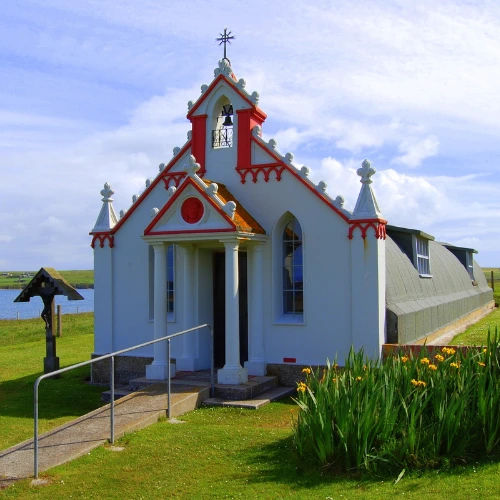
The first stop is the Italian Chapel on Lamb Holm. During World War II, Italian prisoners of war helped build the Churchill Barriers, which protected the waters around Scapa Flow. In their spare time, they turned two simple huts into a chapel using the materials they had available.
From the inside, you can see painted walls, a decorated altar and detailed artwork created by the prisoners.
The area around the chapel is flat, and the building can be entered by wheelchair via a ramp. There is one step near the altar, however this can be still from the accessible area.
Entrance fees apply and can be paid directly on the day.
After your visit, your driver takes you across the Churchill Barriers, which connects several of Orkney’s islands.
Scapa Flow and Scorradale Road
Next, you continue along Scapa Flow, an important naval base during both World Wars. Your driver will also take you along Scorradale Road, where you can enjoy views of the hills of Hoy, the town of Stromness and the surrounding waters. There will be an opportunity to stop for photos.
Skara Brae and Skaill House
Your driver then takes you to Skara Brae, a village that dates back more than 5,000 years. The stone houses were buried beneath sand dunes for centuries before a storm uncovered them in 1850. Today, you can still see stone beds, shelves and other features that show how people lived thousands of years ago.
The path from the visitor center to the site is suitable for wheelchair users. Disabled parking is available, and the visitor center is accessible. On the site itself, wheelchair users can follow the route about halfway around before needing to turn back. You can still see the village, but the full route is not accessible by wheelchair.
You can also see the nearby Skaill House, a historic house dating back to the 17th century. Wheelchair access is limited to the ground floor though, as the upper floors can only be reached by stairs.
The visitor center has a café where you can stop for lunch.
Entrance fees for Skara Brae and Skaill House are paid directly on the day. One companion can enter for free.
Ring of Brodgar
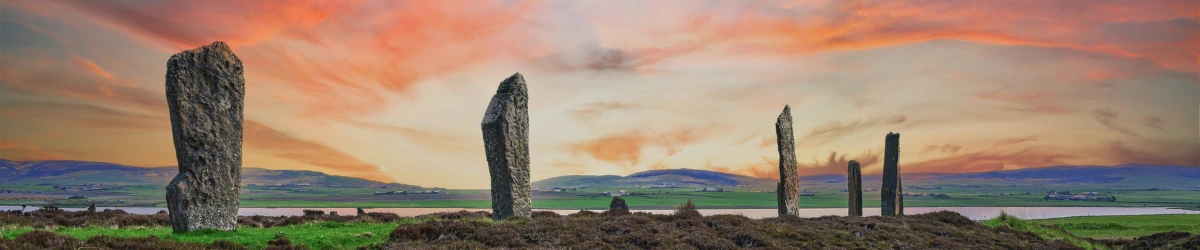
You then make your way to the Ring of Brodgar, a large stone circle, built thousands of years ago. It is part of the Heart of Neolithic Orkney UNESCO World Heritage Site and stands between two lochs.
From the car park, a path leads to the stone circle. The path has a plastic grid surface to make it more stable. Wheelchairs with larger front wheels are better suited to this path, as smaller front wheels may get caught in the grid.
Standing Stones of Stenness
Leaving the Ring of Brodgar, your driver guide continues to the Standing Stones of Stenness, one of the oldest stone monuments in Britain, dating back to around 3100 BCE.
The stones stand close to the road, with parking nearby. The surrounding area has grass and fine gravel, which may be uneven in places.
Optional Stop: St Magnus Cathedral
If time allows, you can visit St Magnus Cathedral in Kirkwall. Built in the 12th century, the cathedral is known for its red and yellow stone walls and long history. Entry is free, and the stop depends on the time available during your tour.
Optional Stop: Scapa Distillery
You can also choose to visit Scapa Distillery, located beside Scapa Flow. Here, you can learn about local whisky-making and browse the shop.
Due to the age of the building, wheelchair access is limited. However, wheelchair users can enter the warehouse, tasting room and shop. The visit depends on the time available and the distillery’s opening hours.
Return to Kirkwall
At the end of your tour, your driver will take you back to the Kirkwall cruise port or your accommodation in the city center.
This tour combines Orkney’s ancient history, wartime stories and beautiful coastal views, with practical accessibility information to help you plan your visit.